
Feathers are the most complex integumentary (skin-associated) structures ever evolved by vertebrates. They first developed in dinosaurs more than 200 million years ago as protofeathers – single, wispy filaments likely used for insulation – and, since then, have diversified into a myriad of different specialised structures.
Birds of a feather
Different uses of feathers:
- Waterproofing and floating – ducks.
- Swimming – penguins.
- Bracing – woodpeckers use the tail as a strut while clinging to trees and hammering.
- Improving their hearing – the facial disk seen in some owls helps to channel sounds to their ears, so that they can hear their rodent prey in the dark.
- Muffling or creating sound – owls’ wing feathers are modified for silent flight, and clapper larks use their wings to make clapping sounds during their territorial display.
- Constructing nests – many species line their nests with down feathers.
- Carrying water – desert-living sandgrouse land belly-deep in water and then return to the nest with sodden feathers from which their chicks can drink.
- Escaping from predators – doves can drop their tail feathers when grabbed by a predator, allowing them to escape tailless but unharmed.
- Camouflage – feathers can closely match the environment in colour and pattern.
- Territorial and sexual display – bright colours and specialised feathers in males demonstrate their health and, thus, suitability as a mate to the females. Good examples include peacocks, birds of paradise and widowbirds.
- Most spectacular of all, specialised feathers give birds the ability to fly.
Feather quality
The metabolic (energy) cost of growing feathers is very high, which means that, if the bird is not in top health and condition, the feather quality will be poor. We, as bird owners, can use the quality of the feathers to judge the health of the bird.
Healthy feathers should be well formed and the barbules (microscopic hooks that join the feather filaments together) should all be linked (giving the bird a smooth, uniform appearance).
The coloured areas on the feathers should be bright, without black marks or atypical patches of yellow, pink or otherwise abnormal colours.
Abnormalities
There are multiple feather abnormalities that indicate specific diseases and conditions. Focusing mainly on the parrot family, several are listed below:
- Frayed or broken feathers often indicate that the bird is exhibiting feather destructive behaviour (FDB). Typically, this means the bird is experiencing some type of discomfort. Plucking feathers over a specific area can mean that the bird is experiencing pain there. We’ve found anything from bone and tissue injuries to lung and kidney infections playing a role.
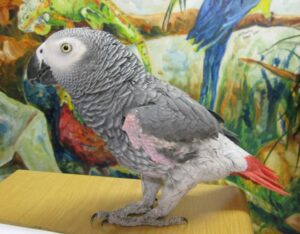 This bird began to pull out all her wing feathers after an incorrect wing trim caused discomfort.
- Psychological issues, such as fear, separation anxiety, boredom and hormonal imbalances, can also lead to feather destructive behaviour.
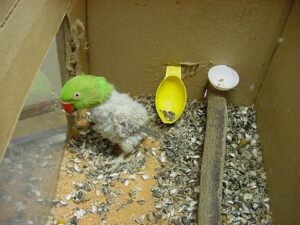 This bird was on a very poor diet and lived in totally inappropriate housing. Note the presence of feathers on the head where she cannot reach. This canary has developed a feather cyst.
- Discoloured feathers (for example, a pale pink feather on the body of an African grey, or a yellow feather in between what should all be green feathers) may indicate damage to that feather follicle, liver disease or a viral disease, such as psittacine beak and feather disease (PBFD).
- PBFD is a highly infectious virus with a high mortality rate and is unfortunately very common in South Africa.
One sign allows us to easily distinguish FDB from PBFD: unless the parrot has a cage-mate, who is biting off the bird in question’s head feathers, a bird plucking out his own feathers will have a beautifully feathered head, as he cannot reach this area to pluck, whereas a bird with PBFD will have poor, scant feathering all over his body.
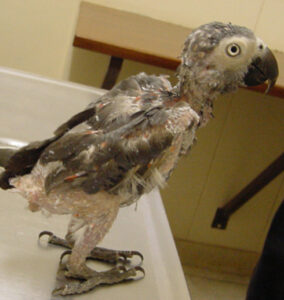
Advanced psittacine beak and feather disease.
- Many parrot species have been bred to display colour morphs, where the feathers are
a different colour to those of wild birds of the same species (for example, green ringneck parakeets occur in white, yellow, blue, dark green, cobalt and mixed colours). Many a naïve individual has been fooled into purchasing a bird of ‘rare’ colour, when, in fact, the bird is actually ill, and the feather colour changes are not the result of genetics, but rather of disease.
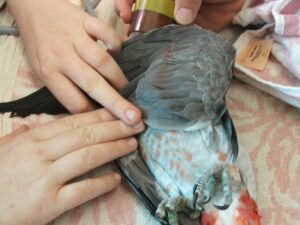
The pink wash to the feathers is a genetic trait.
Poor nutrition
By far the most common reason for poor-quality feathering in our pet parrots, is poor nutrition. Birds fed a diet consisting mainly of sunflower seeds and peanuts suffer from multiple nutritional deficiencies, including low levels of vitamin A, calcium and as many as 10 other vitamins and trace elements. Parrots need to be fed a diet consisting largely of good-quality pellets and/or a balanced cooking mix, with the addition of veggies, some fruit and either a small amount of high-quality seed or a few nuts. PLEASE do not feed peanuts to your bird. They are often contaminated with fungi that, if inhaled by your bird, can cause fatal fungal lung disease.
Should you notice that your bird has questionable feather quality, please consult your avian veterinarian, who will be able to get to the source of the problem and help you to correct the situation.

